January 1, 2026
AI Automation
Enterprise Translation Automation: Leveraging Gemini & LLMs for Multilingual Ops
Google's integration of Gemini into Translate changes the game. Learn how to leverage these state-of-the-art models via API to build secure, automated translation pipelines for your business.
Enterprise Translation Automation: Leveraging Gemini & LLMs for Multilingual Ops
Google's recent integration of Gemini models into Google Translate validates the shift toward context-aware AI translation. However, for B2B operations, relying on a public web interface is insufficient. Enterprises must implement custom translation pipelines using API-connected LLMs (like Gemini 2.5 Pro or GPT-4o) orchestrated via tools like n8n.io or Make.com to ensure strict data privacy, adherence to corporate glossaries, and automated document processing capabilities.
The Shift from Static Translation to AI Reasoning
Google recently announced the deployment of its state-of-the-art Gemini models into Google Translate. This update improves the handling of nuances, slang, and context. While this is excellent for general users, businesses operating in multilingual hubs like Switzerland—navigating German, French, Italian, and English simultaneously—face challenges that a simple web interface cannot solve.
For an enterprise, translation is not just about converting words; it is about maintaining brand voice, securing proprietary data, and integrating into existing workflows without copy-pasting text.
Why Public Translation Tools Fail in B2B
Using the standard, consumer-facing Google Translate (even with Gemini) presents three specific risks for high-level business operations:
Data Privacy Leakage: Free web tools often use input data to train future models. Financial or legal documents should never pass through public interfaces.
Lack of Terminological Consistency: A generic model does not know your specific internal acronyms or industry-specific syntax (e.g., distinguishing 'Bond' in finance vs. chemistry).
No Workflow Automation: Manually inputting text is unscalable when dealing with thousands of customer support tickets or technical documentation pages.
The Solution: Custom Translation Agents & RAG
At Fleece AI Agency, we bypass the consumer interface to build Translation Agents that connect directly to LLM APIs. By using orchestration platforms like n8n or Make, combined with Python scripts, we create pipelines that outperform standard tools.
Technical Architecture Example
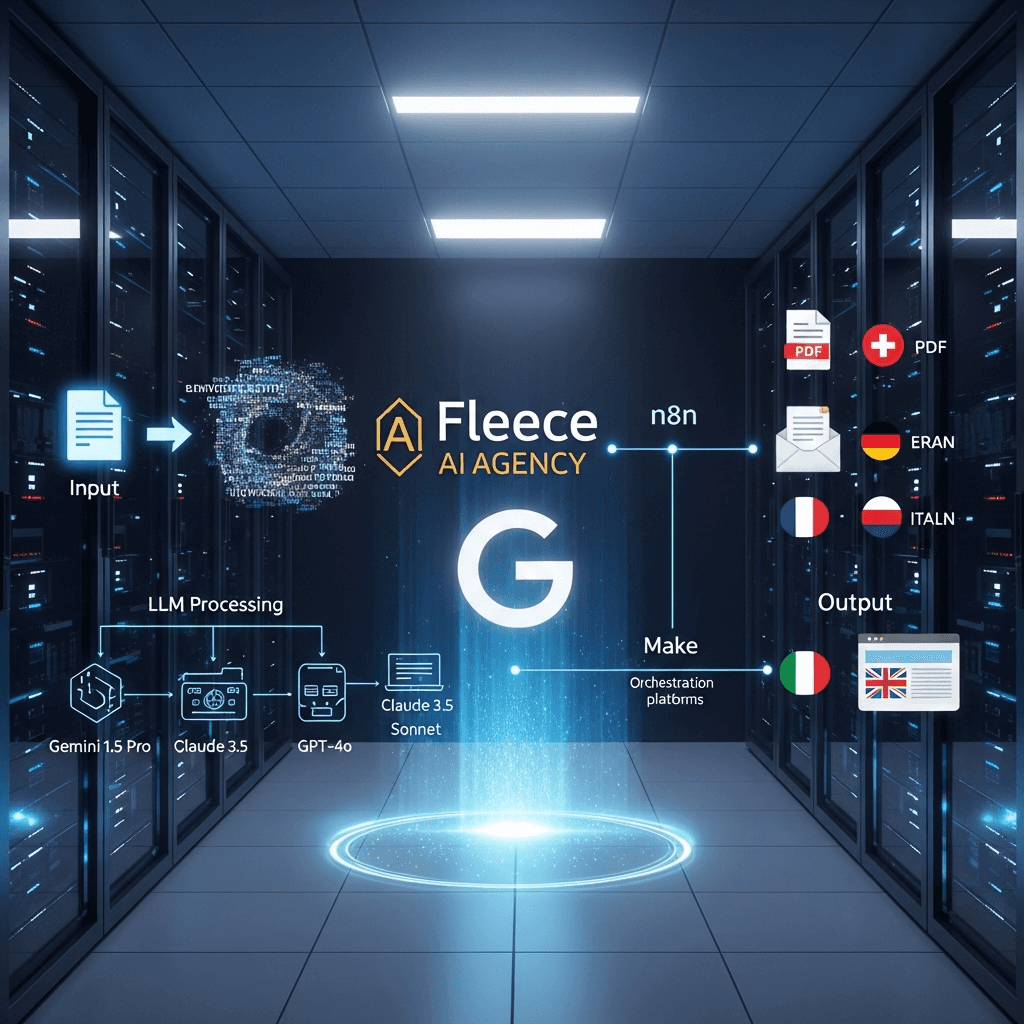
Here is how a state-of-the-art B2B translation pipeline works:
Input Trigger: A document arrives in a SharePoint folder or a ticket lands in Zendesk.
Context Retrieval (RAG): The system queries a Vector Database (like Pinecone) containing your company's Glossary and Brand Guidelines.
LLM Processing: We send the text + the retrieved context to Gemini 2.5 Pro or Claude 4.5 Sonnet via API. We instruct the model to: \"Translate into German, strictly adhering to the attached glossary, maintaining a formal banking tone.\"
Quality Check Agent: A secondary LLM agent reviews the translation for hallucinations or syntax errors.
Output: The translated document is automatically saved as a PDF or sent back to the client.
Comparative Analysis: Public vs. Custom
Feature | Public Google Translate | Fleece AI Custom Pipeline |
|---|---|---|
Engine | Gemini (General) | Gemini/GPT-4o (Fine-tuned/Prompted) |
Data Privacy | Standard Google T&C | Zero-retention API (SOC2 Compliant) |
Context Awareness | Limited to input | Full Company Knowledge Base (RAG) |
Scalability | Manual Copy-Paste | Unlimited Automated Batches |
Real-World Use Case: Swiss Financial Reporting
We recently assisted a Zurich-based wealth management firm. They needed to translate daily market analysis reports from English into French and German for their local clients.
The Challenge: Human translators were too slow for daily updates, and standard machine translation missed specific financial nuances, risking compliance issues.
The Fleece AI Solution: We deployed an n8n workflow connecting the company's CMS to the Gemini API. The system now:
Detects new articles instantly.
Translates content while cross-referencing a 'Do-Not-Translate' list for proper nouns and fund names.
Formats the output directly in HTML for their website.
Result: 90% reduction in translation costs and near-instant publication in three languages, with human experts only needed for final spot-checks.
Conclusion
Google's update proves that LLMs are the future of translation. However, to harness this power for business, you need more than a text box; you need an integrated system.
Stop relying on manual tools that expose your data. Contact Fleece AI Agency today to audit your multilingual workflows and implement secure, automated AI translation pipelines tailored to your enterprise.
📩 Contact: contact@fleeceai.agency
©2025 Fleece AI. All rights reserved.