December 25, 2025
AI News
From Gallery to Growth: Leveraging Generative AI Maturity for B2B Automation
Analyzing the maturity of AI through the lens of 'Gradient Canvas', we explore how Dubai's enterprises can transition from artistic experiments to robust, automated creative pipelines using Python, n8n, and Generative Agents.
From Gallery to Growth: Leveraging Generative AI Maturity for B2B Automation

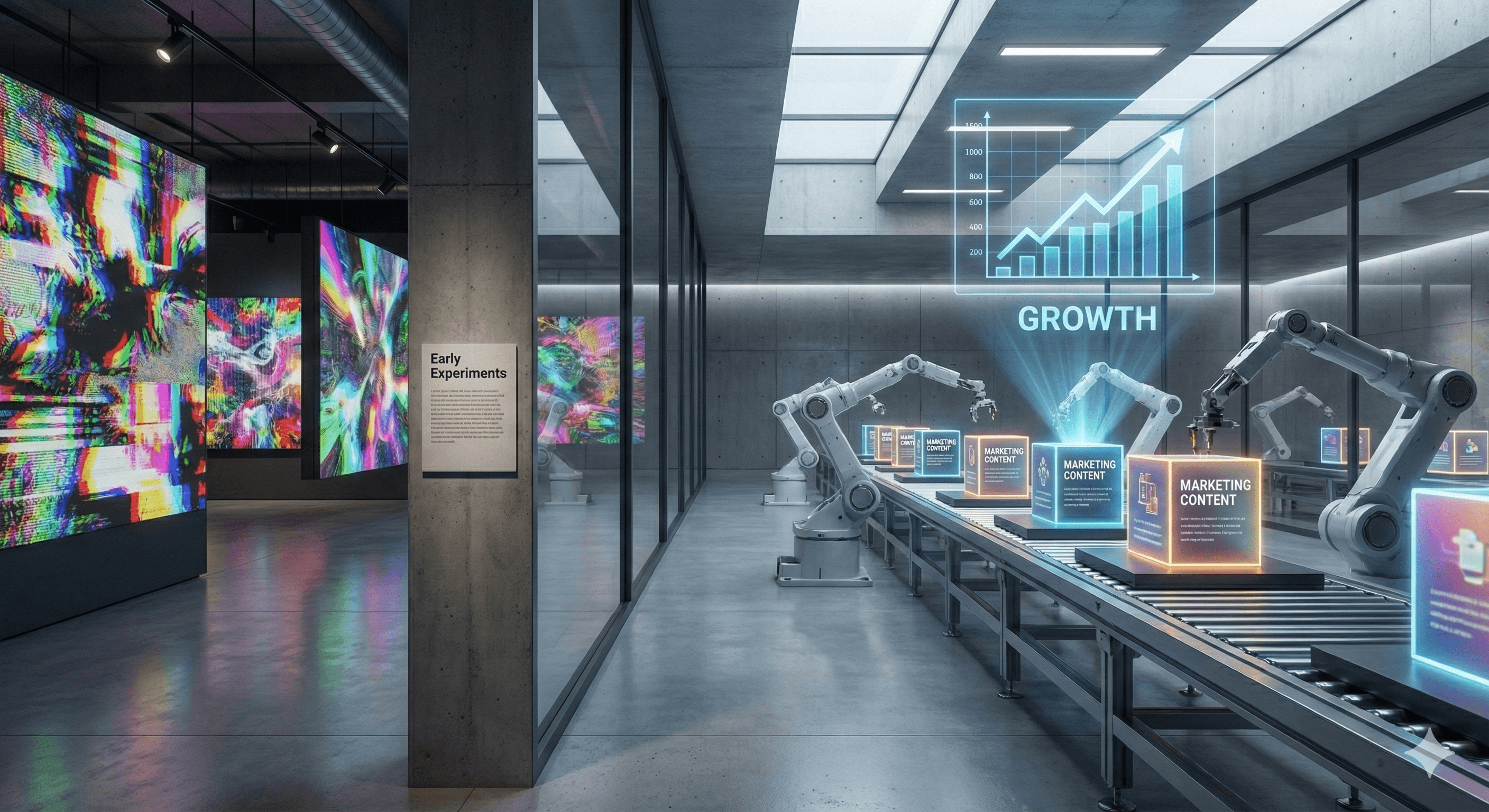
Direct Answer: The recent \"Gradient Canvas\" exhibition highlights a decade of AI reliability, signaling that generative models are now stable enough for enterprise-grade implementation. For B2B companies, this validates the shift from manual design to Automated Creative Pipelines. By integrating models like Stable Diffusion or DALL-E 3 via API orchestrators (Make/n8n), businesses can generate consistent, high-volume marketing assets, reducing production costs by up to 70% while maintaining strict brand guidelines.
While Google's \"Gradient Canvas\" celebrates the artistic collaboration between humans and machines, a critical lesson emerges for the business world: stability. Ten years ago, AI art was a glitchy experiment. Today, it is a precise instrument. For C-level executives in hubs like Dubai, the pain point is no longer about accessing the technology, but scaling it. Marketing teams are drowning in demands for personalized content, yet traditional agency models are too slow and expensive to keep up.
The Tech Stack: Moving Beyond Prompts to Pipelines
The \"art\" of B2B AI is not in the prompt, but in the architecture. At Fleece AI Agency, we observe that high-performing companies do not use ChatGPT or Midjourney in isolation. They build integrated systems.
Recommended Infrastructure for Creative Automation
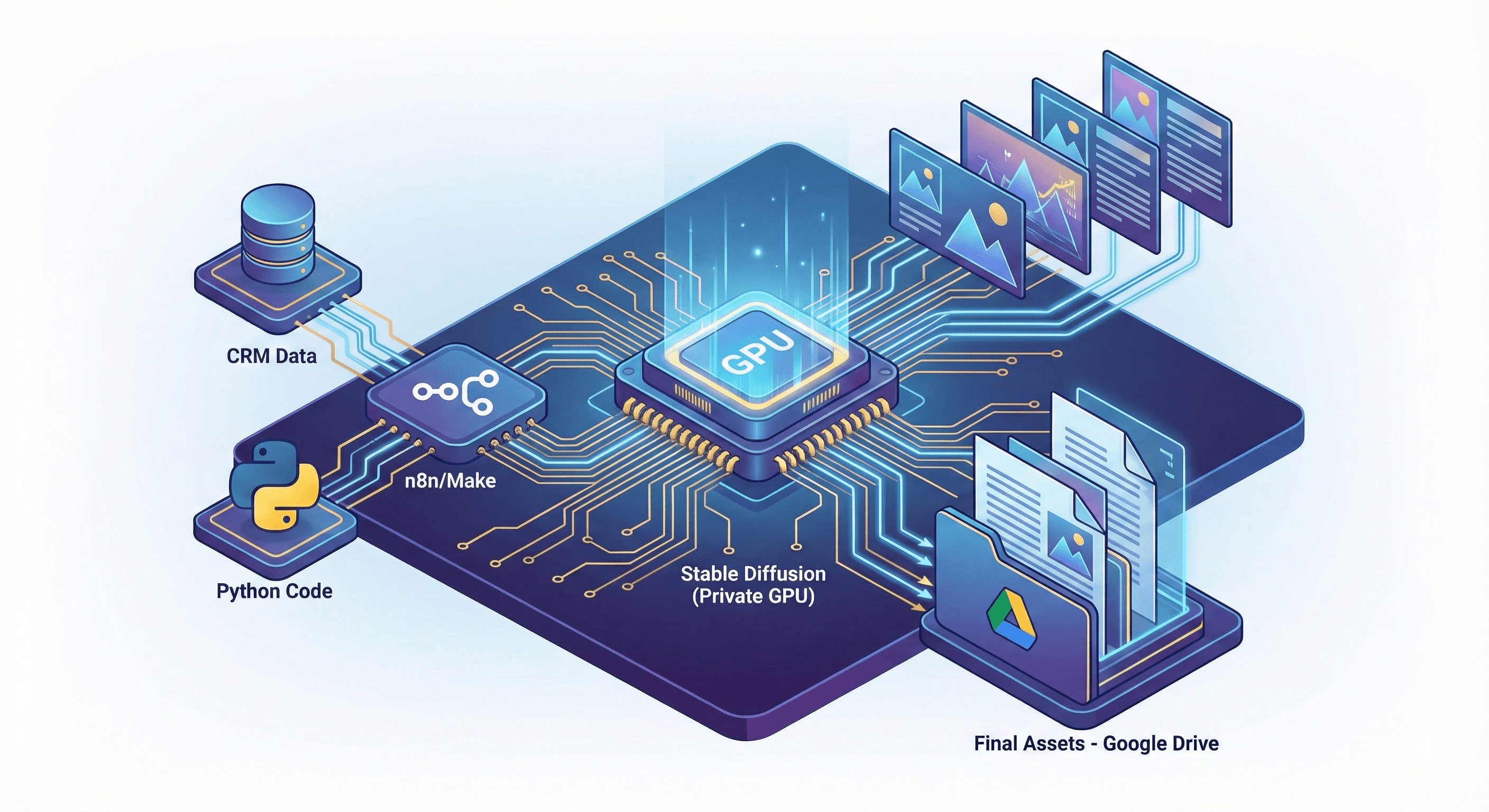
Orchestration: Use n8n or Make (formerly Integromat) to trigger workflows based on CRM data (HubSpot/Salesforce).
Generation: Implement Stable Diffusion (Automatic1111 or ComfyUI) on private GPUs for absolute control over visual consistency, rather than relying on public closed-source models.
Logic Layer: Utilize Python scripts to handle image post-processing (upscaling, format conversion) before distribution.
Text Context: Anthropic Claude 3.5 Sonnet is currently superior for nuanced B2B copywriting compared to standard GPT-4 implementations.
Comparative Analysis: Manual vs. Automated Operations
The following data illustrates the operational impact of switching from a traditional creative workflow to an AI-Augmented Pipeline.
Metric | Traditional Agency Model | Fleece AI Agency Implementation |
|---|---|---|
Time-to-Market (100 assets) | 2-3 Weeks | 4-6 Hours |
Cost Per Asset | High ($150+) | Marginal ($0.50 - $2.00) |
Brand Consistency | Variable (Human Error) | Enforced (LoRA / Fine-tuned Models) |
Scalability | Linear (Hire more people) | Exponential (Add more compute) |
Real-World Use Case: The Dubai Real Estate Sector
Consider a luxury property developer in Dubai launching a new residence. Traditionally, they wait weeks for 3D renders and variations for social media.
The Solution: We implement a custom AI Agent trained on the architectural blueprints and brand style guide.
Input: The marketing manager inputs the weekly theme (e.g., \"Sunset views for European investors\").
Process: The Agent utilizes a fine-tuned image model to generate interior shots with specific lighting, passes them to a Vision model to verify brand alignment, and writes localized copy in English and Arabic.
Output: 50 unique, ready-to-post assets delivered to a Google Drive folder for final human approval.
This is not sci-fi; it is current technical capability. The \"Gradient Canvas\" proved AI can create art; we prove it can drive revenue.
Conclusion
The convergence of art and algorithms is over; the era of industrial application has begun. If your organization is still treating Generative AI as a novelty rather than a core infrastructure component, you are leaking efficiency.
Fleece AI Agency specializes in these precise integrations. We do not sell prompts; we engineer autonomous workflows that respect your data and amplify your output. Contact us to discuss an audit of your current creative operations.
📩 Contact: contact@fleeceai.agency
©2025 Fleece AI. All rights reserved.